
Press release:
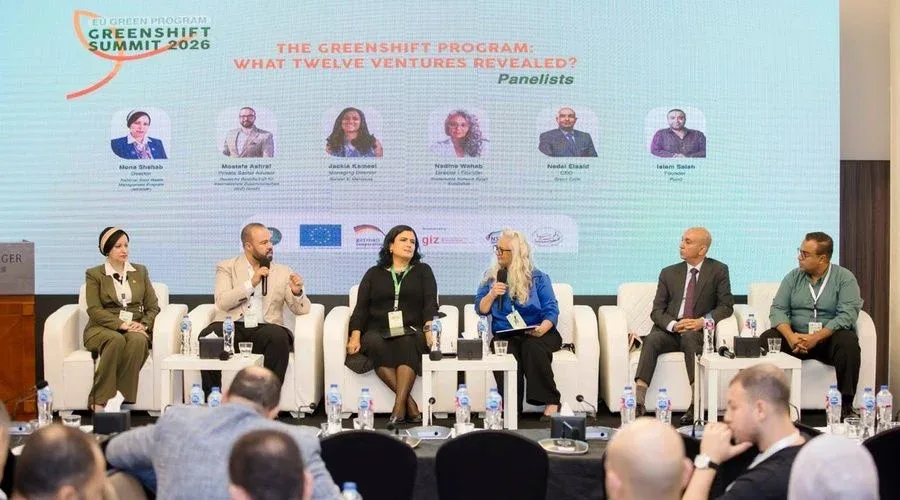
Nahdet El Mahrousa (NM), the first incubator for early-stage social enterprises in Egypt and the Middle East, hosted the GreenShift Summit on Tuesday, 27 October, bringing together more than 150 industry leaders, policymakers, investors, development partners, and entrepreneurs to explore what it takes to turn promising green businesses into scalable companies and how their growth can drive change across industries.
The summit spotlighted the journeys of 12 green scaleups based in Greater Cairo and the Delta, which received acceleration support and a total of EGP 57.5 million in investment through the GreenShift Program. Implemented by Nahdet El Mahrousa in partnership with the Deutsche Gesellschaft für Internationale Zusammenarbeit (GIZ) GmbH and co-funded by the European Union and the German Federal Government, the program supports green enterprises in commercializing their solutions and scaling their impact.
Emphasizing the importance of empowering startups to drive sustainable economic growth, Dr. Mona Shehab, Director of the National Solid Waste Management Programme, said: “Startups play an important role in building a stronger, more sustainable national economy by generating innovative ideas and creating new opportunities that contribute to economic growth and help advance the country’s future development plans.”
At the operational level, Mostafa Ashraf, private sector advisor at GIZ, highlighted one of the key challenges these businesses face as they work to scale: access to equipment financing. “One of the biggest challenges facing these businesses is the high upfront cost of equipment. The GreenShift program helps address this challenge by financing machinery, enabling companies to continue developing their operations and improve their production processes.”
The graduating scaleups operate across a range of sectors, including climate action, the circular economy, and waste management and recycling. They are:
● TileGreen Tech: Transforms hard-to-recycle plastic waste into durable building materials using patented technology.
● Tilestic: Converts single-use plastic waste into tiles, paving stones, and roof tiles.
● Green Cycle for Waste Management: Collects and processes post-consumer plastic waste into certified raw materials for local manufacturers.
● EGYMAG Biotechnology: Uses black soldier fly larvae to convert organic waste into protein, oil, and fertilizer.
● Extractor Co.: Produces essential oils through a circular process that returns plant residues to the soil.
● Mycelium: Uses mushroom-based technology to transform agricultural waste into mushrooms and plastic alternatives for packaging and construction.
● Up-Fuse: Creates everyday products by repurposing plastic and textile waste through a slow-fashion approach.
● ZEE: Produces circular footwear from discarded shoes and other waste materials.
● Yadawee: Produces and exports handmade Egyptian crafts created by local and refugee artisans.
● Mrkoon: Operates a B2B marketplace connecting businesses with verified buyers and sellers of scrap and surplus materials.
● PLANQ Electronics: Develops upgradable computers using recycled materials and repurposed laptop batteries.
● VeryNile: Works to protect the Nile through cleanup initiatives, recycling, environmental education, and community development.
Islam Salah, founder of PLANQ Electronics, emphasized the program’s role in helping the company develop a viable business model around its recycling operations. “The funding mattered, but so did the expertise and guidance we received. The program gave us the confidence to pursue opportunities we might not have explored otherwise,” he added.
Echoing this sentiment, Dr. Tarek Makram, founder of Extractor Co., said the funding and expert guidance he received through GreenShift helped accelerate the factory setup process. “GreenShift stood out because it offered more than advice, combining funding with training, advisory services with hands-on support.”
The GreenShift Program received 1,353 applications and trained 46 fellows through approximately 160 hours of training, consultations, and a retreat. It also provided EGP 1.3 million in productive assets to 18 fellows and supported eight of the 12 funded scaleups in licensing and formalizing their businesses.
Held under the theme “Rethinking Tomorrow: From Green Businesses to Changing Industries,” the one-day summit convened stakeholders from government entities, NGOs, development agencies, financial institutions, research and academia, corporations, and entrepreneurship support networks.
Participants included representatives from the Ministry of Local Development and Environment, the National Solid Waste Management Programme, and the Industrial Development Authority, alongside ّGIZ, United Nations Industrial Development Organization (UNIDO), the European Bank for Reconstruction and Development (EBRD), Sawiris Foundation for Social Development, Injaz Egypt, Finance in Motion, Dar Ventures, Hassan Allam Holding, Orascom Development, Flat6Labs, and AUC Venture Lab, among other ecosystem partners.
The “GreenShift” summit opened with a welcome and keynote session, followed by “The GreenShift Program: What Twelve Ventures Revealed,” highlighting the experiences, achievements, and key lessons of the green scaleups supported by the program.
Discussions then turned to investment readiness and growth through “Will You Invest? What Makes a Green Business Worth Backing” and “Ready to Scale. Now What?”, examining what makes green businesses commercially viable and what they need to expand. Sector-focused panels explored how sustainable materials could transform construction and how bio-based alternatives could reshape traditional agricultural practices.
“Public-private partnerships are at the heart of Egypt’s sustainability agenda. The GreenShift Summit underscored the importance of cross-sector collaboration in advancing environmental, social, and governance (ESG) practices, strengthening sustainable value chains, and accelerating Egypt’s transition to a greener economy. Building on this collaborative approach, the GreenShift Program supports green enterprises at different stages of development, helping early-stage innovators commercialize their solutions while enabling growing companies to scale their impact. Together with our public- and private-sector partners, we aim to nurture the next generation of climate entrepreneurs and accelerate the adoption of sustainable solutions across industries,” said Jackie Kameel, Managing Director of Nahdet El Mahrousa.